Around Billings, Cattle Money Is Going Into Pasture Rent
November 26, 2026
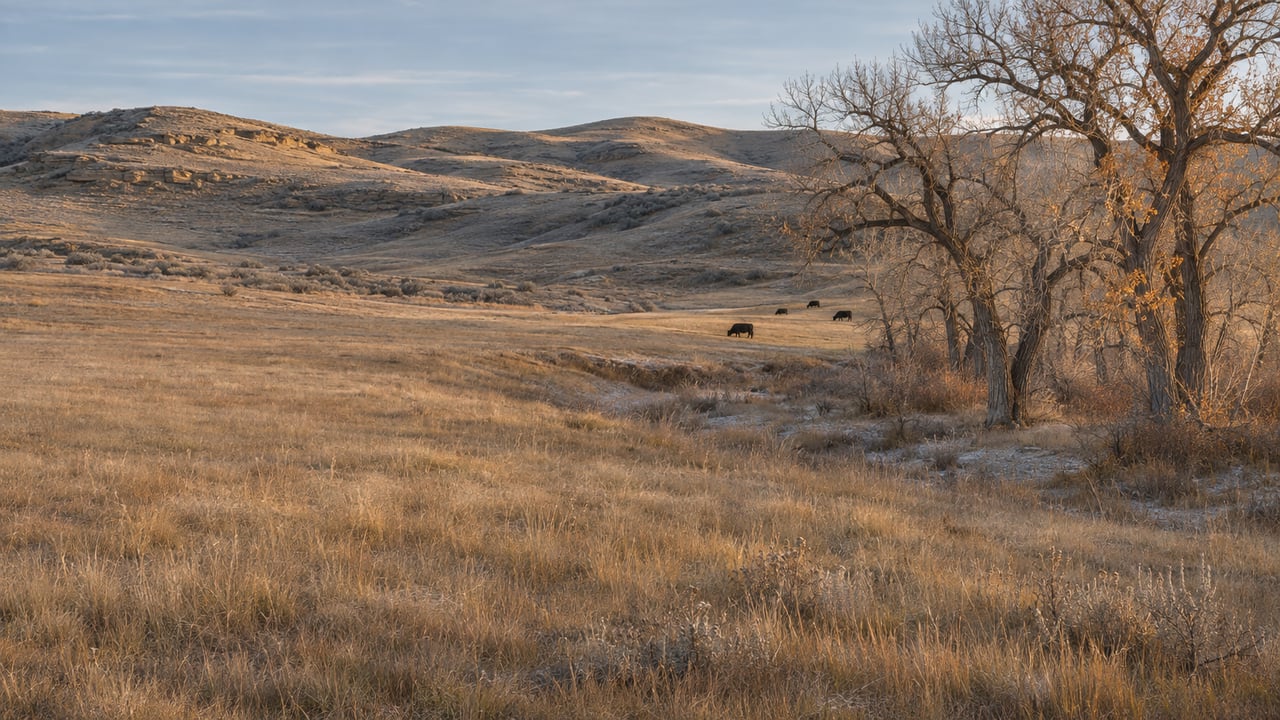
The Thursday sale at Billings Livestock Commission on November 19 was a lighter run than usual: 2,842 head, all feeder cattle, against 3,694 on the same week a year earlier. Buyers had to piece loads together from small and moderate packages, and the USDA market report for the sale noted that most of the calves were cutbacks from summer video sales. That afternoon, 94 head of unweaned steer calves averaging 538 pounds brought $447.47 per hundredweight, and 133 head averaging 577 pounds brought $417.63. At that price a single 538-pound calf is worth about $2,400.
Across town, Public Auction Yards' November 13 sale put 225 head of 534-pound steers at $451.84 per hundredweight. These are some of the strongest calf checks south-central Montana has seen. Very little of that money has shown up in what grazing land sells for around Billings. It has shown up in what grazing land rents for, and anyone comparing ranches in the Billings corridor this winter should understand why.
This fall's prices are less a spike than a plateau. A year ago, at the November 20, 2025 sale at the same barn, unweaned 500- to 550-pound steers averaged $445.34 and 550- to 600-pound steers averaged $424.07. The weight bands and lots are not identical from year to year, but calves of the same size are bringing about what they brought twelve months ago.
The price has also moved within the year. Northern Ag Network reported on October 14 that cattle markets hit record highs earlier in summer 2026 and then fell back, and its outlook called for feeder cattle to trade mostly sideways through the end of the year. So a ranch buyer this winter is looking at two years of calf income at about these levels, with a market that has already shown it can drop.
For a rancher, a high calf price is a reason to run more cows, and more cows need more grass. The fastest way to get more grass is a lease, and the 2026 cash rent figures look like ranchers took it.
USDA's county cash rent estimates, released August 21, 2026 and compiled by TallyTill, show pasture rent in Yellowstone County at $6.50 an acre for 2026, up 18.2% from $5.50 in 2025. Statewide, Montana pasture rent rose 9.6% over the same year, from $8.30 to $9.10 an acre. The surrounding counties mostly moved the same way:
| County | 2025 pasture rent per acre | 2026 pasture rent per acre |
|---|---|---|
| Yellowstone | $5.50 | $6.50 |
| Stillwater | $8.10 | $9.50 |
| Carbon | $9.00 | $10.00 |
| Big Horn | $6.40 | $6.90 |
| Musselshell | $5.60 | $5.60 |
The Yellowstone County estimate carries a 23.5% coefficient of variation, so read the exact jump loosely. The direction is consistent across most of the region, though. Higher rent also shows up on crop ground. Irrigated cropland in Yellowstone County rented for $132 an acre in 2026, up from $120, and non-irrigated cropland went from $26.50 to $27.50. The $132 against $27.50 is the same water premium that runs through our comparison of irrigated and dryland acreage near Billings.
These per-acre figures leave out a large share of grazing deals. USDA's cash rent survey excludes land rented by the AUM or under other non-cash arrangements. Those leases have their own benchmarks. Montana State University Extension's grazing table puts private non-irrigated grazing at $29.50 per animal unit month and $32.50 per cow-calf pair per month in 2025, the latest year it shows, up from $29.00 and $31.50 in 2024. On state trust land, the Montana DNRC has posted a grazing rate of $33.85 per AUM for the 2027 season.
USDA's Land Values 2026 Summary, released July 31, puts Montana pasture at $940 an acre in 2026, up 2.2% from $920 in 2025. Cropland rose 2.3%, from $1,320 to $1,350. These are statewide averages, and USDA does not publish a county land value for Yellowstone County. Even so, the gap is large. Statewide pasture rent rose 9.6% in a year when statewide pasture value rose 2.2%.
Statewide, $9.10 of annual pasture rent on $940 of pasture value is a gross return a little under 1%. Yellowstone County's $6.50 against the same statewide value is about 0.7%. The rent is a county figure and the value is a state figure, so this is an illustration, not a cap rate. But no plausible change in the inputs gets grazing income close to what money earns elsewhere. If pasture were priced on what cattle can pay for it, an 18% jump in rent would move the price. A 2% move tells you the price is set somewhere else.
AgWest Farm Credit's August 2026 land values update supports this. It reports that good-quality agricultural land and cattle ranches across Montana remain in high demand, with limited supply holding values steady or slightly higher. It also notes that high beef prices have put some ranchers in a position to expand, which supports grazing land values. AgWest adds that many Montana production ag deals are private transactions between landlords and tenants or between neighbors. Cattle money supports land prices around the edges. It does not set them.
The other half of the story is how cautious ranchers are about growing their herds. USDA counted 1,232,000 beef cows in Montana on January 1, 2026, down from 1,252,000 a year earlier. Replacement heifers rose to 310,000 from 305,000, a small increase. The state's 2025 calf crop was 1.21 million head, down from 1.24 million in 2024. The herd is not rebuilding quickly.
The breeding stock market shows that the cattle needed for expansion have become expensive. In its recap of the 2025–2026 sale season, Western Ag Reporter's auctioneers reported year-over-year increases of 30% for commercial heifer calves, 55.2% for bred heifers and 30.6% for bred cows across their territory. A rancher who wants more cows pays up for the cows first. Buying the land to run them on as well is a second, much larger bet.
Ty Thompson, an auctioneer and cattle sale manager at Billings Livestock Commission, put the decision plainly to Montana Free Press in August: "What you have to have is economic incentive to not sell that heifer." In that article he described federal beef import policy as adding uncertainty for ranchers who want to grow their herds. Montana State University agricultural economist Eric Belasco told the outlet, "We've already seen futures prices go down because of this." When the price outlook can change with an announcement, a lease you can walk away from in a year looks much better than land you would carry for decades. That preference shows up in the 2026 rents.
For a buyer comparing working ranches around Billings, Laurel, Columbus or Roundup, these figures lead to one practical conclusion. The cattle can pay the rent. They cannot pay for the land. A ranch's grazing income this year is real and well documented, and it will probably cover the operating side of the place. The purchase price reflects other things. AgWest's report points to scarcity of good-quality ground. Owners who know a ranch also value its water, its access and its position next to a neighbor who may want to expand.
That changes the questions that matter during due diligence. Ask what the rent roll and any grazing leases would earn at today's rates, because those rates have reset upward and the seller's history may understate them. Ask how much of the asking price the cattle income could ever support, and treat the rest as the price of owning that particular ground. For irrigated ground, the Yellowstone County rent gap between irrigated and dryland acres shows where the income per acre actually comes from. Our earlier guide to pricing a working ranch in the Billings area covers how comparable sales and income approaches fit together. In 2026, pasture rents near 1% of statewide pasture value put a wide distance between the two.
For a seller, the timing reads differently. Calf prices that have stayed near the top for a year, rents that just reset higher, and a short supply of good ground together help a listing make its case to an operator. The 2% statewide value number says buyers are not yet bidding land up to match the calves. Pricing has to rest on the land's own scarcity and qualities, not on this fall's sale barn reports. More on the Billings corridor is on our Billings neighborhood page.
The rents, grazing rates and land values above are dated benchmarks for general information. They are not legal, tax or financial advice, so confirm your own lease terms and figures with your lender, accountant or attorney.
If you own grazing ground or a working ranch around Billings and want to know how this year's rents and cattle prices bear on what your land would sell for, Mod West Real Estate can walk through it with you privately. Request a Confidential Valuation, and we will start from your acres, your water and your leases.
Stay up to date on the latest real estate trends.

Get assistance in determining current property value, crafting a competitive offer, writing and negotiating a contract, and much more. Contact Stacie today to discuss all your real estate needs!
Let's Get Started